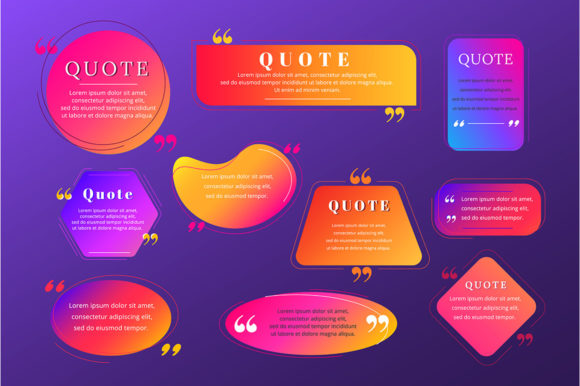
Review: Quote Blank Frame Vector Template Set
As a designer who has spent countless hours digitizing for hoop art and managing client expectations, I have learned that the foundation of any great embroidery project is not just the thread choice, but the underlying structure of the design itself. Recently, I evaluated the Quote Blank Frame Vector Template Set to determine its viability for real-world production. This collection features red, orange, blue, and purple gradient speech bubbles, along with circular and rectangular empty textbox backgrounds designed for messages, comments, and notes. While marketed broadly under Graphic Templates and Graphics, my focus was strictly on how these vector assets translate into tangible, stitched realities for crafters and small business owners.
First Impressions and Visual Personality
The immediate appeal of this set lies in its versatility. The gradient speech bubbles offer a modern, digital-native aesthetic that contrasts interestingly with the tactile nature of embroidery. When I first opened the files, I noticed the clean lines of the quotation and citation text box designs. For an embroidery designer, clean lines are non-negotiable. They dictate how well a machine can follow a path without excessive jumps or trims. The mood here is playful yet professional, suitable for a wide range of applications from casual social media-style quotes to structured informational labels on handmade goods.
The visual personality of the Quote Blank Frame Vector Template Set suggests it belongs in projects that require a focal point for text. Whether you are creating a personalized gift or branding items for a boutique, the frame acts as a container that draws the eye. However, because these are vectors intended for customization, the final look depends entirely on how you adapt them for stitching. The gradient colors mentioned in the description—red, orange, blue, purple—are vibrant, but in embroidery, we must consider how these translate to thread. Gradients in embroidery require careful blending of thread colors or specific fill techniques to avoid a blocky appearance.
Real-World Application Scenarios
To test the practicality of this set, I imagined several common scenarios faced by Etsy sellers and craft business owners. Consider a custom tote bag design. A rectangular frame from this set could be stitched onto a canvas tote, serving as a label for a library book return or a grocery list. The sturdy nature of canvas supports the stitch density required for a defined border. Alternatively, imagine a sweatshirt embroidery project for a university club. The speech bubble shape is perfect for containing a team motto or a funny inside joke. The curved edges of the bubble soften the look on the chest area, making it feel approachable and friendly.
Another strong use case is in baby embroidery. Parents love personalized items, and a soft pastel version of these frames could hold a baby’s name or birth stats on a onesie or blanket. The circular empty textbox background is particularly useful here, as circles are inherently soothing and fit well on smaller garments. For holiday embroidery, such as Christmas ornaments or gift tags, the compact nature of these frames allows for high-impact designs on small fabric squares. The key is recognizing that these are not just decorative elements; they are functional containers for communication, which adds value to the finished product.
Technical Considerations for Stitching
While the visual potential is high, translating a vector template into a successful machine embroidery design requires technical diligence. One must consider stitch density. If you convert these vector shapes directly into satin stitches without adjusting the width, you risk creating a dense, stiff patch that may pucker lightweight fabrics. For larger frames, a fill stitch might be more appropriate, but this increases production time and thread usage. For thinner outlines, a running stitch or a narrow satin stitch works best, providing definition without bulk.
Fabric texture plays a crucial role. On textured fabrics like towels or fleece, fine details can get lost. If you are using the Quote Blank Frame Vector Template Set on a kitchen towel, ensure the line weight is substantial enough to stand out against the loops of the terry cloth. Conversely, on smooth cotton or polyester blends, the design will appear crisp and clear. When working with stretchy fabrics, such as those used in custom apparel like t-shirts, proper stabilization is critical. A cut-away stabilizer is recommended to prevent the frame from distorting after washing.
Special care is needed for curved surfaces like caps. Embroidering a speech bubble on a cap requires careful hooping and possibly a foam backing to raise the design. The gradient effect described in the product details would be challenging to replicate perfectly on a curved surface without advanced digitizing skills. In such cases, simplifying the color palette to solid blocks might yield a cleaner, more professional result for an embroidered patch or direct-to-garment application.
Enhancing Product Value and Brand Consistency
Using consistent design elements like those found in the Quote Blank Frame Vector Template Set can significantly boost brand recognition for small shop products. If you sell a line of literary-themed gifts, using the quotation mark motifs consistently across mugs (via sublimation) and tote bags (via embroidery) creates a cohesive brand identity. Customers trust brands that present a unified visual language. Furthermore, these frames add perceived value to a personalized gift. A plain notebook becomes a special keepsake when adorned with a custom-stitched frame containing the recipient’s favorite quote.
For digital embroidery file sellers, offering these frames as part of a bundle can attract buyers looking for customizable options. However, it is essential to provide clear instructions on how to resize the frames without compromising stitch integrity. Buyers appreciate when designers anticipate these technical hurdles. Including tips on hoop size compatibility and recommended thread weights can reduce customer support queries and increase satisfaction.
Practical Designer Notes and Best Practices
Before committing to a large production run or listing a new item in your small shop product lineup, always test the design on scrap fabric. This step allows you to check thread tension and color contrast. Test the design in black and white mockups first to ensure the shape holds up without relying on color gradients for definition. Compare the look on light and dark fabric backgrounds; you may need to add a underlay or change thread colors to maintain visibility on dark materials.
Inspect small details closely. If the vector template includes tiny corners or intricate joins, these may need simplification for embroidery. Machine needles can struggle with sharp turns in dense areas. Confirm that the design works for both personal and commercial projects by reviewing the license terms associated with the Graphic Templates. Never assume commercial rights are included unless explicitly stated. Finally, consider the end-user experience. Will the stitched frame survive frequent washing? Will it remain soft against the skin if placed on a baby item? These questions define the difference between a good design and a great product.
In conclusion, the Quote Blank Frame Vector Template Set offers a robust foundation for creative embroidery projects. Its strength lies in its adaptability across various mediums, from commercial embroidery runs to one-off handmade treasures. By approaching these vectors with a digitizer’s mindset—respecting stitch density, fabric behavior, and technical limitations—you can transform simple graphic assets into high-quality, marketable embroidered goods. Whether you are an experienced designer or a hobbyist looking to elevate your craft, this set provides the structural elegance needed to make your text-based designs stand out.